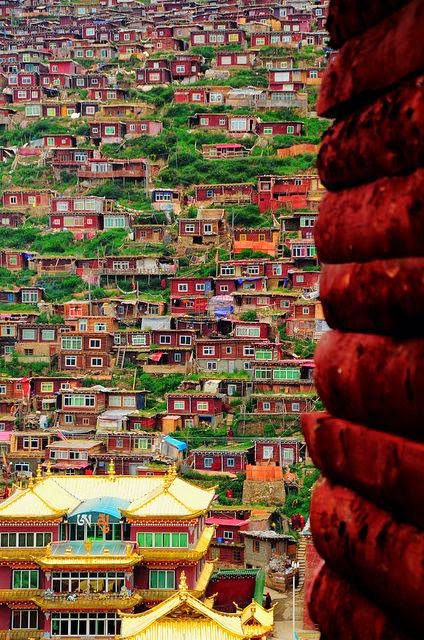
The world's largest Buddhist Institute Sertar Buddhist Institute, Sichuan, China

http://en.wikipedia.org/wiki/Serthar_Buddhist_Institute#Buddhist_Institute 

In 1980, Khenpo Jigme Phuntsok founded Serthar Institute, known as Larung Gar Buddhist Academy, in the Larung Valley near the town of Sertar, Garze Prefecture, Sichuan Province. The purpose of the Institute has been to provide an ecumenical training in Tibetan Buddhism and to meet the need for renewal of meditation and scholarship all over Tibet in the wake of China’s Cultural Revolution of 1966-76.

Despite its remote location, it grew from a handful of disciples gathering in Khenpo's home to be one of the largest and most influential centers for the study of Tibetan Buddhism in the world, numbering to nearly 10,000 monks, nuns, and lay disciples by the year 2000. Sources

Standing guard for 2400 years, The Terracotta Army, Xi'an, China

http://en.wikipedia.org/wiki/The_Terracotta_Army#Background 


The Terracotta Army or the "Terracotta Warriors and Horses" is a collection of terracotta sculptures depicting the armies of Qin Shi Huang, the first Emperor of China. It is a form of funerary art buried with the emperor in 210–209 BCE and whose purpose was to protect the emperor in his afterlife.

The Terracotta Army was discovered on 29 March 1974 to the east of Xi'an in Shaanxi province by a group of farmers digging a water well approximately 1.6 kilometres (0.99 mi) east of the Qin Emperor's tomb mound at Mount Li (Lishan), a region riddled with underground springs and watercourses. For centuries, there had been occasional reports of pieces of terracotta figures and fragments of the Qin necropolis –roofing tiles, bricks, and chunks of masonry having been dug up in the area. This most recent discovery prompted Chinese archaeologists to investigate, and they unearthed the largest pottery figurine group ever found in China. Sources

Colorful Munich, Germany

http://en.wikipedia.org/wiki/Munich,_Germany#The_inner_city 

Munich is the capital and largest city of the German state of Bavaria. It is located on the River Isar north of the Bavarian Alps. Munich is the third largest city in Germany, after Berlin and Hamburg. About 1.56 million  people live within the city limits.

At the centre of the city is the Marienplatz, a large open square named after the Mariensaule, a Marian column in its centre with the Old and the New Town Hall. Its tower contains the Rathaus-Glockenspiel. Three gates of the demolished medieval fortification have survived to this day the Isartor in the east, the Sendlinger Tor in the south and the Karlstor in the west of the inner city. The Karlstor leads up to the Stachus, a grand square dominated by the Justizpalast and a fountain. Sources


Burg Eltz Castle, Germany

Eltz_Castle 

Eltz Castle is a medieval castle nestled in the hills above the Moselle River between Koblenz and Trier, Germany. It is still owned by a branch of the same family that lived there in the 12th century, 33 generations ago. The Rubenach and Rodendorf families' homes in the castle are open to the public, while the Kempenich branch of the family uses the other third of the castle.

The castle is surrounded on three sides by the Elzbach River, a tributary on the north side of the Moselle. It is situated on a 70 m rock spur, on an important Roman trade route between rich farmlands and their markets. Sources

Impressive Holocaust Monument, Berlin, Germany

Memorial_to_the_Murdered_Jews_of_Europe 

The Memorial to the Murdered Jews of Europe, also known as the Holocaust Memorial is a memorial in Berlin to the Jewish victims of the Holocaust, designed by architect Peter Eisenman and engineer Buro Happold. It consists of a 19,000 m2 (4.7-acre) site covered with 2,711 concrete slabs or "stelae", arranged in a grid pattern on a sloping field. The stelae are 2.38 m (7 ft 10 in) long, 0.95 m (3 ft 1 in) wide and vary in height from 0.2 to 4.8 m (7.9 in to 15 ft 9.0 in). According to Eisenman's project text, the stelae are designed to produce an uneasy, confusing atmosphere, and the whole sculpture aims to represent a supposedly ordered system that has lost touch with human reason. 

A 2005 copy of the Foundation for the Memorial's official English tourist pamphlet, however, states that the design represents a radical approach to the traditional concept of a memorial, partly because Eisenman did not use any symbolism. However, observers have noted the memorial's resemblance to a cemetery. An attached underground "Place of Information" (German: Ort der Information) holds the names of all known Jewish Holocaust victims, obtained from the Israeli museum Yad Vashem.

Building began on April 1, 2003 and was finished on December 15, 2004. It was inaugurated on May 10, 2005, sixty years after the end of World War II, and opened to the public two days later. It is located one block south of the Brandenburg Gate, in the Friedrichstadt neighborhood. The cost of construction was approximately €25 million. Sources


Blogger Template by Clairvo